John Carpenter’s Assault on Precinct 13 begins with a city that appears to have room for everyone. Cars move through Los Angeles, a police officer reports for duty, and a prison transport follows its route. Gradually, those separate movements converge on a nearly abandoned police station. By nightfall, space has become a trap.
Released in 1976, the film takes a straightforward premise and makes every part of it count. A small group must defend a building against attackers who vastly outnumber them. Help is unavailable, communication breaks down, and the people inside must decide whom they can trust.
What distinguishes the film is the precision of its execution. Carpenter makes doors, windows, corridors and patches of darkness dramatically useful. His characters have enough personality to matter without requiring elaborate biographies. His music gives the night a threatening pulse.
Almost everything serves the same purpose: keeping the audience aware that the defenders are running out of options.
This article discusses major plot developments, including the ending.
The Story: Strangers Forced to Survive Together
Lieutenant Ethan Bishop, played by Austin Stoker, receives an apparently uneventful assignment at a Los Angeles police station being closed. With operations winding down, the building has few staff and little reason to expect trouble.
Elsewhere, a prison transport makes an unscheduled stop because one of its prisoners is ill. Among those aboard are Napoleon Wilson, played by Darwin Joston, and Wells, played by Tony Burton. Their arrival places convicted criminals inside a building where the remaining police presence is already thin.
A separate act of violence brings a traumatized father to the station, pursued by members of the gang Street Thunder. Soon, the people inside find themselves facing an organized assault.
The setup works because nobody has assembled this group deliberately. They occupy the same space through ordinary assignments, unexpected delays and desperate decisions. Their eventual cooperation therefore has to develop under pressure.
Carpenter also gives the audience information that the defenders lack. We understand that separate events are moving toward a collision before Bishop recognizes the danger. Once the siege begins, that advantage becomes frustrating: knowing more about the threat does not give us any way to help.
The official film synopsis identifies the central conflict clearly: isolated police officers and prisoners must cooperate against a gang determined to kill someone inside.
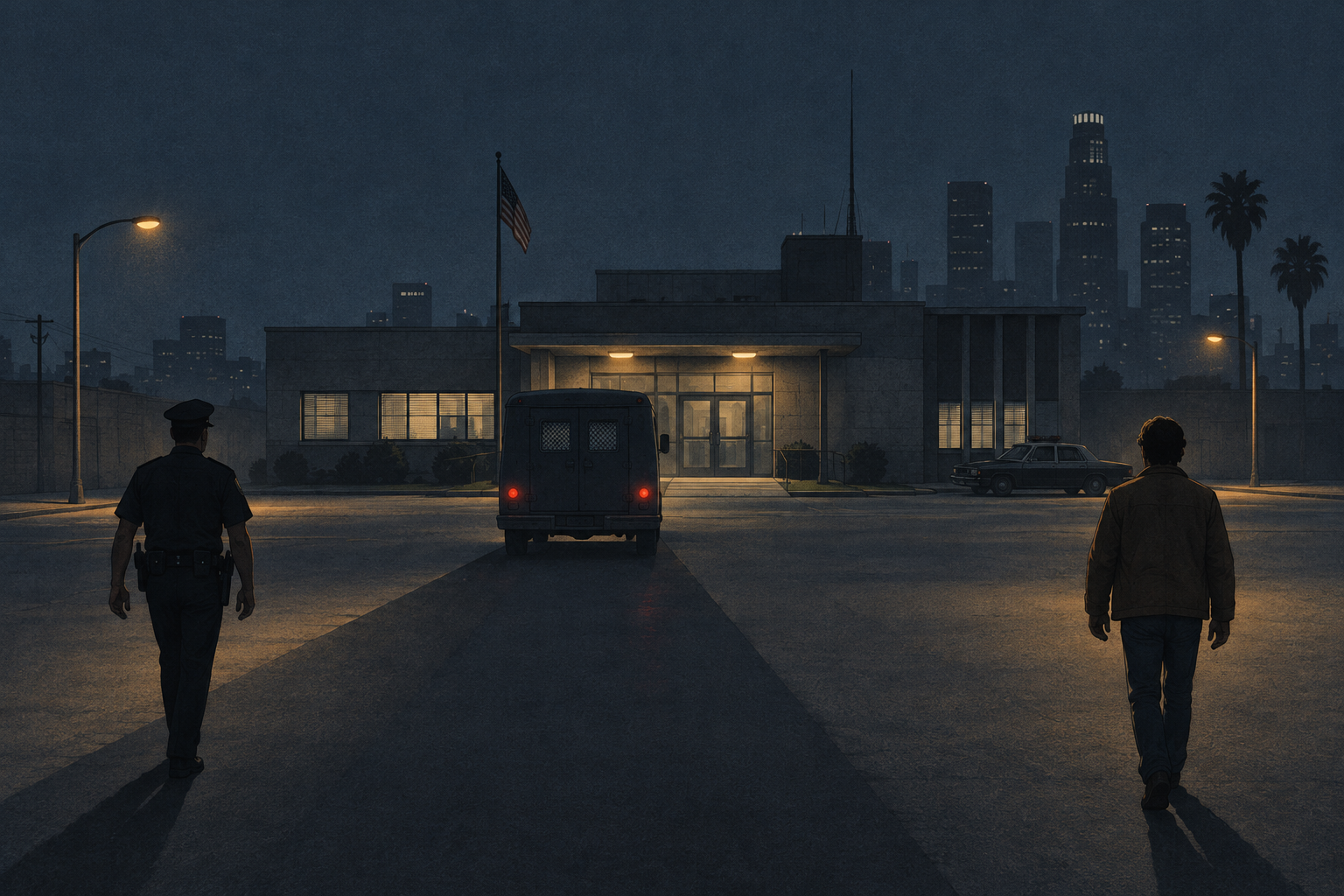

An Early Film With a Confident Identity
Assault on Precinct 13 was Carpenter’s second feature, following Dark Star. It already contains several qualities associated with his later work: enclosed communities, distrust of authority, resourceful outsiders and danger that becomes more frightening through its persistence.
Yet it deserves attention beyond its position in a famous director’s career. Calling it a rehearsal for Halloween understates how completely it understands its own purpose.
Carpenter wrote, directed, composed the music and edited the film, using the editing credit John T. Chance. That concentration of responsibilities helps explain its consistency. Image, rhythm and sound appear to belong to the same conception of suspense. The credits are documented on Carpenter’s official film page.
The production’s modest scale becomes an advantage when the film commits to its central location. Instead of apologizing for the absence of spectacle, it makes the audience study what is available.
A desk becomes cover. A corridor becomes an exposed route. A window becomes an opening the defenders cannot afford to ignore.
The film’s confidence comes from understanding that suspense requires meaningful limitations. Give the characters fewer choices, make those choices clear, and the audience will follow every decision.
A Western Inside a Police Station
The connection to Howard Hawks’ Rio Bravo is fundamental. Carpenter admired Hawks, and his official biography describes Assault on Precinct 13 as an urban reworking of that western’s central situation.
The resemblance extends beyond a group defending a building. Both films place considerable weight on competence, loyalty and the gradual recognition of another person’s worth.
In Carpenter’s version, uniforms and criminal records initially define relationships. Bishop represents lawful authority; Wilson is a prisoner. The siege forces both men to discover whether those labels tell them enough about each other.
The answer emerges through behavior. Who stays calm? Who notices a danger? Who risks something for another person? The building becomes a place where character is tested through practical action.
Wilson’s manner also belongs to the western. His relaxed speech and guarded history give him the quality of a gunfighter who has wandered into the wrong decade.
Carpenter discussed this approach in a 1978 interview published by Sight and Sound. He wanted a contemporary western with stylized heroes.
The result remains accessible without recognizing the reference. You do not need to know Hawks to understand why two men covering each other’s backs might develop respect.

How the Film Turns Into Horror
Although the story involves police officers, prisoners and a street gang, its atmosphere often belongs to horror.
The attackers become frightening partly because their individuality recedes. Once the assault gathers force, they behave less like criminals pursuing a negotiable objective and more like an external force pressing against the building.
There is little room for bargaining. The defenders cannot locate a reasonable opponent and explain the misunderstanding. Their uncertainty is therefore practical and psychological: they do not know how many attackers remain or what will stop them.
The comparison with Night of the Living Dead is useful here. Both films trap a vulnerable group inside a structure whose boundaries become increasingly difficult to defend. Windows and doors mark the separation between temporary safety and overwhelming danger.
Carpenter also makes the surrounding city feel disturbingly absent. A police station should connect its occupants to a larger network of assistance. Here, it becomes an isolated structure despite its urban location.
That contradiction gives the film much of its unease. The characters are not stranded in a remote wilderness. They are surrounded by a city that seems unable to register their predicament.
The horror lies in discovering how little protection proximity to other people can provide.
Ethan Bishop: Authority Earned Through Conduct
Austin Stoker’s performance gives the film a stable centre. Bishop is observant, courteous and professional without seeming invulnerable.
He does not arrive as a legendary officer or an unusually aggressive man. His initial assignment appears routine, and Stoker allows him to occupy that routine naturally. This makes the change in circumstances more persuasive.
During the siege, Bishop’s authority depends on his ability to respond rather than his ability to announce that he is in charge.
He must reconsider assumptions quickly. The prisoners cannot remain merely a security problem when they may also be essential to everyone’s survival. Maintaining control requires judgment, including the willingness to trust someone the institution has already condemned.
Stoker avoids turning that decision into a grand display of moral superiority. Bishop acts because the circumstances demand it, and the performance gains strength from that restraint.
His steadiness also gives the audience a point of orientation. Other characters bring panic, mystery or exhaustion; Bishop brings the effort to understand what is happening and act usefully.
The film’s heroism begins there, in continued attention to the problem when fear would make withdrawal understandable.
Napoleon Wilson and the Appeal of the Unknown
Darwin Joston’s Napoleon Wilson is the film’s most immediately memorable character.
He arrives with the reputation of a dangerous prisoner, yet his behavior is often more controlled than that of the people responsible for transporting him. His dry remarks suggest someone accustomed to circumstances becoming unpleasant.
Carpenter withholds much of his history. That omission works because Wilson’s presence supplies what a longer explanation might weaken. Joston’s pauses, posture and delivery create the impression of a life beyond the frame.
The uncertainty also keeps the audience working. We are invited to judge Wilson through what he does now while remaining aware that his past has consequences.
His humor helps him retain some control over a situation in which he has very little formal power. A casual request or perfectly timed remark can briefly change the emotional temperature of a room.
Still, Wilson would be tiresome if he existed only to deliver clever lines. His usefulness during the siege gives the performance substance. He earns attention through action as well as attitude.
The growing bond with Bishop works because neither man has to become the other. Respect develops without requiring complete agreement, friendship or a convenient rewriting of the past.
Leigh and the Importance of the Supporting Cast
Laurie Zimmer’s Leigh is essential to the film’s balance. Her composure prevents the alliance inside the station from becoming exclusively a relationship between two men.
She observes, responds and participates. Carpenter gives her competence a direct physical expression rather than repeatedly asking other characters to explain how capable she is.
Her exchanges with Wilson also create an unusual tone. Attraction and humor remain possible under terrible circumstances, but neither removes the danger. Their conversation suggests people preserving recognizable parts of themselves while their surroundings collapse.
Nancy Kyes, credited as Nancy Loomis, provides a contrasting register as Julie. Her distress makes the situation feel less like an adventure designed for unusually cool people.
Tony Burton’s Wells brings another kind of practicality. His presence broadens the group and reminds the audience that cooperation does not eliminate individual fear or the desire to escape.
These differences matter. If everyone reacted with Bishop’s steadiness or Wilson’s composure, the siege would become emotionally flat.
The supporting performances give the station a range of responses to danger. Some people organize, some joke, some panic, and some look for a way out. The film needs all of them.
Suspense Built From Rooms and Sightlines
Carpenter’s handling of space is among the film’s greatest strengths.
Before the siege reaches its most intense passages, the audience has developed a workable understanding of the station. We recognize routes between rooms, understand which openings face outside and see where people are positioned.
This clarity allows the action to produce suspense rather than confusion. When someone leaves cover, the risk is legible. When a defensive position becomes untenable, we understand why the group must move.
Cinematographer Douglas Knapp helps create images that make empty space active. A dark area at the edge of the frame can attract attention even before anything enters it.
The audience begins scanning alongside the characters.
Carpenter also changes the meaning of familiar features. Windows usually allow people inside a building to observe the outside. During the siege, they expose the occupants. Doors offer movement but also access to attackers. Corridors connect rooms while leaving anyone crossing them vulnerable.
The station is never literally alive, yet its usefulness changes with the situation.
This is why the film does not need a succession of elaborate locations. One building contains enough dramatic possibilities when the director makes its structure understandable and then systematically removes its protections.
The audience can measure the deterioration of safety.
The Ice-Cream Scene and the Film’s Cruelty
The killing of a young girl near an ice-cream truck is the film’s most notorious moment.
Its force comes partly from the ordinary nature of the situation. A child wants an ice cream. A small disappointment brings her back toward the vendor. Carpenter places extreme violence inside a moment that usually belongs to everyday reassurance.
The scene does several things at once. It motivates the father’s actions, establishes the gang’s willingness to kill without hesitation and removes any comfortable assumption about who the film will protect.
It also raises a legitimate objection. The child receives little development beyond what is required to make her death shocking. Viewers may reasonably feel that the film uses her primarily as an instrument for advancing the plot.
That criticism does not erase the scene’s effectiveness. It identifies the uncomfortable means by which the effect is achieved.
Carpenter’s abruptness makes the violence difficult to absorb. The film gives little opportunity to prepare emotionally before the event has occurred.
Afterward, the siege carries a harsher implication. Survival cannot be assumed because a character seems innocent, sympathetic or narratively important.
The film has demonstrated that its violence will not always follow reassuring dramatic etiquette.
The Electronic Score Gives the Night Its Pulse
Carpenter’s score is inseparable from the film’s identity.
The main theme uses repetition to suggest forward movement without relief. Its electronic sound feels impersonal, as though the danger continues operating independently of anyone’s emotions.
That quality suits the attackers. They remain outside much of the defenders’ knowledge, while the music makes their presence felt across the film.
The score also establishes unease before the station comes under sustained attack. Ordinary movement through the city acquires a threatening direction. We watch people travel while the music implies that something is already in motion.
The BFI’s assessment of Carpenter’s essential soundtracks places Assault on Precinct 13 among his strongest musical achievements.
Its effectiveness, however, depends on more than a memorable theme. Carpenter understands the value of leaving room for other sounds.
Gunfire, footsteps and pauses become more noticeable when music does not explain every emotional shift. Silence can make the audience uncertain about whether danger has passed or merely changed position.
The contrast between rhythmic music and exposed quiet gives the film a useful tension. One suggests inevitability; the other makes the next moment unpredictable.
It is a score built to support the images while possessing enough character to remain memorable after them.
Editing, Waiting and the Shape of the Siege
The film’s opening movement is patient. Carpenter follows separate characters before bringing them together, allowing each strand to establish a slightly different expectation.
Bishop anticipates routine work. The prison transport suggests procedural movement. The father and daughter occupy an ordinary civilian afternoon.
Crosscutting gradually brings those expectations into contact.
Once the siege begins, the rhythm changes, but Carpenter does not maintain a constant level of intensity. Attacks are followed by pauses, reassessment and attempts to understand what remains possible.
These intervals allow consequences to register. A damaged position stays damaged. A missing person creates an absence. Ammunition and access become problems that cannot be solved through enthusiasm.
The quiet passages also prevent the gunfire from becoming background noise. An action sequence feels more forceful when the film has allowed anticipation to accumulate beforehand.
Some viewers may find the early pacing slow. The criticism is understandable, particularly when approaching the film as a continuous action spectacle.
Yet the setup gives the later confinement its meaning. We have seen people moving freely through the city. When they can no longer leave a building, the restriction feels like a change in their circumstances rather than the film’s default condition.
Race, Institutions and the Film’s Moral Boundaries
The alliance between Bishop and Wilson crosses both a legal division and a racial one. A Black police officer and a white prisoner become mutually dependent within a situation that strips away many of their expected roles.
The film does not pause to turn that relationship into an explicit social argument. Its meaning emerges from practical cooperation and the respect attached to it.
Institutional authority is treated with similar complexity. Bishop remains sympathetic, but the institution represented by the station cannot protect its occupants. The building has been left behind administratively before it becomes isolated physically.
This makes personal conduct more important than institutional appearance.
There is a limitation to that moral approach. Inside the station, the film asks us to look beyond labels. Outside, the gang is given much less individuality. The attackers become a largely anonymous threat against which the central characters can demonstrate their humanity.
That imbalance is worth acknowledging. The film’s generosity toward its defenders depends partly on denying comparable depth to their opponents.
Its strongest moral idea concerns the people it allows us to know: a person’s official status does not exhaust what they may be capable of doing for someone else.
The Ending and the Film’s Lasting Reputation
The final defensive stand reduces the survivors’ choices to an improvised act of resistance. By this stage, the station has ceased to offer credible safety. Survival requires using what remains of the building and its contents against the attackers.
The physical resolution matters, but the emotional ending belongs to Bishop and Wilson.
Their treatment of each other after the siege recognizes an obligation created by shared action. Wilson’s past has not vanished. Bishop’s responsibilities have not disappeared. What has changed is that each man has seen the other behave under extreme pressure.
Carpenter allows that recognition to carry the ending without an extended explanation.
The film’s reputation also developed beyond its initial release. The BFI’s history of the London Film Festival identifies its 1977 festival screening as an important moment in securing wider attention and distribution.
Its continued appeal is easy to locate in the work itself. The performances remain distinctive, the score retains its force, and the action is unusually clear.
Assault on Precinct 13 understands the value of making the audience care about a few people in a specific place. Once that connection exists, a dark window, an unanswered question or the sound of approaching movement can do the work of a much larger production.