Assault on Precinct 13 found a receptive audience at the 1977 London Film Festival, turning a disappointing early American reception into an opportunity for John Carpenter. The screening helped establish the film as an accomplished thriller rather than a disposable exercise in screen violence. It also gave British audiences an early reason to take Carpenter seriously, before Halloween made his name much more widely known.
London’s importance rests on three connected developments: enthusiastic programming, an openly appreciative audience and a route into British theatrical distribution. Those developments belong together, but they are not interchangeable. Festival approval gave the film attention; distribution allowed that attention to reach beyond the festival.
This screening represents one turning point within the film’s broader release and festival history. Its importance becomes clearer when London is treated as a breakthrough, not as the beginning of the film’s public life.
How the Film Reached London in 1977
The London appearance followed earlier screenings and an unsuccessful attempt to establish the film in its home market. The American Film Institute’s release history records its Los Angeles opening on November 3, 1976, followed by a Cannes screening in May 1977 and an Edinburgh Film Festival booking that August. Favorable responses from British critics helped move the film along that festival route.
| Stage | Date | Place in the Film’s Reception |
|---|---|---|
| Los Angeles opening | November 3, 1976 | The original American release preceded the British breakthrough. |
| Cannes screening | May 1977 | British critical interest began building before London. |
| Edinburgh Film Festival | August 1977 | The film gained another festival platform. |
| 21st London Film Festival | Late 1977 | Audience enthusiasm and industry attention strengthened its prospects. |
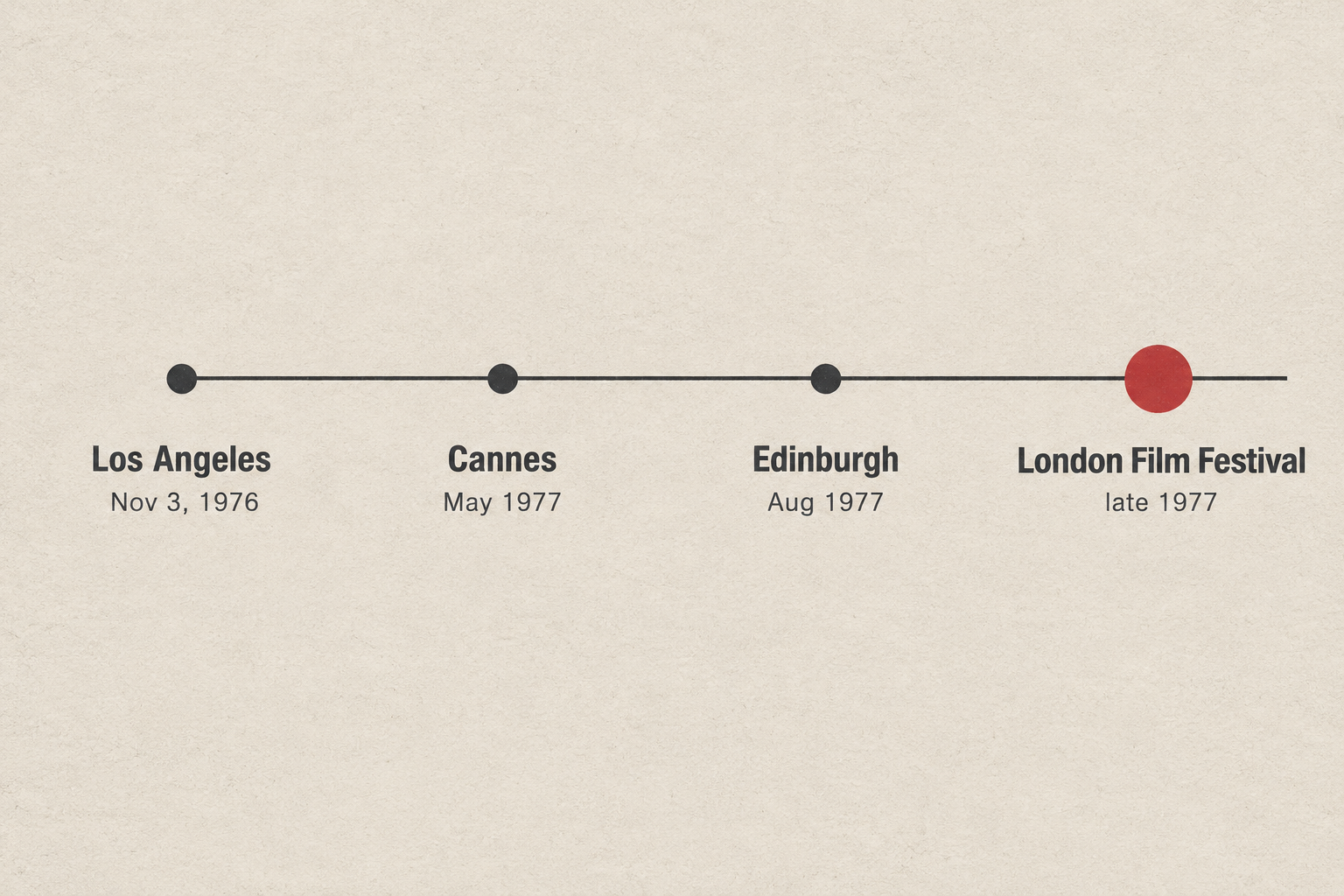
This sequence corrects the tempting version in which a completely unseen film suddenly appeared in London and astonished everybody. The film already had advocates. London gave that developing support a more conspicuous platform.
It also separates the production year from the year of the breakthrough. Assault on Precinct 13 remains a 1976 film. Its celebrated London reception belongs to 1977. A festival can change a film’s reputation without changing its date.
Ken Wlaschin and the Action Cinema Programme
Festival director Ken Wlaschin provided an institutional setting in which Carpenter’s film could be appreciated on its own terms. It appeared in the festival’s Action Cinema strand. The BFI’s history of the London Film Festival identifies its reception there as a catalyst for wider distribution and Carpenter’s career.
The placement suited a festival that had been broadening its programming under Wlaschin. Independent filmmaking and forceful genre pictures could sit alongside established international festival attractions. An American siege thriller did not have to disguise its interest in suspense to deserve attention.
That distinction matters to the story of Assault. Calling it Action Cinema directed attention toward what the film actually does: arrange people within a threatened space, control what they know and make each interruption feel dangerous. Its ambition is expressed through storytelling rather than through an announcement that it is an important film.
There is a useful difference between excusing a modest production and recognizing an effective one. The first response treats achievement as a pleasant surprise given the circumstances. The second asks whether the film works. London’s place in the film’s history rests on the latter response.
The festival setting also offered a productive way to discuss familiar material. A police station under siege could be considered in relation to older American filmmaking without being dismissed as imitation. Familiarity became something to examine, not an automatic reason to move on.
What the Contemporary Account Says About the Audience
The strongest evidence for the audience response comes from writing published close to the event. Tom Milne and Richard Combs’s interview with Carpenter, originally printed in the Spring 1978 issue of Sight and Sound, describes spectators at the London festival cheering and applauding. Its reference to the previous December places that response in December 1977. The contemporary interview and introduction are more useful evidence than a later, embellished account of a legendary evening.
The introduction praised the film’s economy, its connection to older Hollywood filmmaking and its ability to combine suspense with humor. Carpenter, meanwhile, discussed his desire to make audiences care about what happens on screen. He also criticized the American marketing for emphasizing bloodshed rather than the suspense and mystery he believed the film offered.
Together, those observations identify a problem of expectation. Sell a picture principally as a display of violence and its measured setup may look like a delay. Approach it as a suspense film and that same preparation becomes part of the attraction.
The reported cheering is therefore more than a decorative anecdote. It shows that the film’s effects registered with a shared audience. The tension did not require viewers to remain solemn, and the humor did not necessarily undermine the danger.
Still, the surviving account should not be stretched beyond what it establishes. It supports an enthusiastic response. It does not provide an audience survey, a measured duration of applause or proof that every spectator approved.
Why This Thriller Could Reward a Festival Audience
The most persuasive interpretation of the London response begins with the film’s construction. Its central situation is easy to grasp, but easy to grasp does not mean easy to execute. A small group faces an attack; the drama depends on whether the director can keep changes in danger, trust and available space legible.
Film at Lincoln Center’s assessment of the film’s suspense and sound emphasizes its interplay of silence, gunfire, tense conversation and Carpenter’s synthesizers. That description points to a useful distinction: the film’s force does not depend on uninterrupted action. Waiting is part of the design.
Suspense Makes the Audience Participate
A siege story asks viewers to think ahead. Where can the defenders move? Which apparent refuge might become a trap? How long can a pause last before it becomes more worrying than an attack?
These questions encourage active attention without requiring complicated exposition. The audience can follow the immediate problem while remaining uncertain about the next development. A clear situation can produce considerable tension precisely because the consequences are easy to recognize.
Read this way, restraint is not an absence of filmmaking. It is a means of organizing anticipation. An empty stretch of screen can become a threat if the film has taught viewers to watch it.
Humor Gives Tension Somewhere to Go
The mixture of danger and dry humor offers another explanation for the reported response. A joke within a threatening situation can provide relief without making the situation safe. The relief may even sharpen the next shock by briefly relaxing the audience.
There is also a difference between laughing at an unsuccessful thriller and laughing with a film that knows how to manage absurdity. The contemporary account places Assault in the second category. That distinction helps explain why applause and suspense need not be opposites.
Older Genre Traditions Remain Visible
The film also rewards comparison with earlier American cinema. Its enclosed conflict invites attention to professional conduct, improvised cooperation and the question of whom to trust under pressure. These are useful points of comparison, rather than a checklist of borrowed details.
The separate guide to how Rio Bravo influenced Assault on Precinct 13 develops that relationship. For the London story, the relevant point is narrower: recognizing an older storytelling tradition gave critics another way to describe Carpenter’s achievement.
From Festival Approval to British Distribution
The practical result was British distribution through Miracle Films, documented in the AFI history cited above. That outcome gives the festival episode a commercial consequence beyond good reviews. The film had acquired a way to reach paying audiences outside the event.
The surviving advertising offers another piece of the story. The British quad poster preserved by Film on Paper carries Derek Malcolm’s endorsement. It illustrates how critical approval could become part of the film’s public presentation, rather than remaining a conversation among festival attendees.
A poster cannot establish how many tickets an endorsement sold. It can show what a distributor chose to emphasize. Here, a critic’s support became a reason for prospective viewers to give an unfamiliar film their attention.
This is where the difference between reception and distribution becomes tangible. Applause does not sign a contract. Nor does a contract guarantee a lasting audience. But programming, approval, advertising and access can reinforce one another.
The British response also should not be reduced to a claim that one country understood the film and another did not. Release circumstances and expectations offer a more useful explanation than national taste alone. The same film can encounter different audiences under very different descriptions.
What the London Breakthrough Does Not Prove
The festival story is memorable enough to invite exaggeration. Three distinctions keep it useful.
London was not the first public screening. The earlier American release, Cannes appearance and Edinburgh booking belong to the same history. Removing them makes the London event seem more miraculous but less accurate.
Audience enthusiasm is not the same as a formal award. Describing a film as a festival success does not, by itself, establish a jury prize or an official best film designation. Such claims require their own records, not an inference from applause.
A breakthrough is not an instant, universal reversal. Festival attention can change a film’s prospects without immediately reaching every distributor, critic or viewer. The useful question is what opportunities followed, not whether everyone suddenly agreed.
It is equally worth separating the response to the screening from the full range of British reviews that followed. The festival episode records a concentrated moment of approval; it should not stand in for every subsequent critical judgment. The wider discussion belongs in the account of the film’s original critical reception.
These distinctions do not diminish the achievement. They explain it. A film need not emerge from complete obscurity, win a major prize and become an immediate hit for a festival appearance to matter.
Why the 1977 Screening Still Matters
The London Film Festival gave Assault on Precinct 13 a setting in which its suspense, humor and relationship to older genre filmmaking could be recognized together. The contemporary audience account, the distribution history and the British advertising provide different kinds of evidence for that change in fortune.
Its enduring interest lies in the relationship between a film and the expectations surrounding it. The screen did not need different images for the work to receive a different response. A more receptive context could make existing qualities easier to recognize and discuss.
London was therefore an important stage in the film’s development into a cult classic, rather than a complete explanation of that later reputation. The festival helped create an opening. The film’s continuing life depended on audiences having reasons to return to it after the applause had stopped.